
Why African History Matters to Every Person on Earth
- Apr 20
- 9 min read
The ancient civilisations that were buried, the truth that was suppressed and why reclaiming it heals us all
Your ancestors were African. Every single one of them. Long before the first empire rose or the first border was drawn, our collective story began on the African continent and understanding that changes everything.
African history is not a niche subject for academics, nor a topic relevant only to people of African descent. It is the origin story of every living human being on Earth. Yet for centuries, this truth has been hidden, distorted and deliberately erased, replaced by a false narrative that positioned Africa as a continent without culture, without science, and without a history worth studying.
That narrative was a lie. And dismantling it matters not just for African people, but for all of humanity.
In this article, Nuakai Aru and the Wisdom Foragers team explore the depth of Africa’s ancient civilisations, the calculated suppression of African history during the colonial era, the profound cost of that erasure on global culture and identity, and why restoring this knowledge is one of the most important acts of healing we can undertake as a species.

Africa: The Birthplace of Humanity and All Civilisation
When scientists, archaeologists and geneticists speak of the origins of our species, they all point to the same place: Africa. The continent is not merely ancient in human terms, it is the source from which everything else emerged.
The First Humans
The oldest known fossils of anatomically modern humans, Homo sapiens, were discovered in Jebel Irhoud, Morocco, dated to approximately 300,000 years ago. Further east, the Omo Kibish fossils from Ethiopia date to around 195,000 years ago. Every human being alive today is descended from this original African ancestral population.
When the first people began migrating out of Africa roughly 70,000 years ago, they carried with them language systems, tool-making knowledge, spiritual frameworks and a deep understanding of the natural world. These were not primitive wanderers. They were sophisticated, creative and intellectually advanced. The cultures they founded across Asia, Europe and the Americas all carry the fingerprints of their African origins.
DID YOU KNOW Genetic studies confirm that all people alive today share a common female ancestor who lived in Africa approximately 200,000 years ago, a woman scientists call ‘Mitochondrial Eve.’ Every human lineage on Earth, regardless of race, nationality or geography, traces back to her. |

The Great Civilisations of Ancient Africa
Long before Greece, Rome or any European civilisation existed, Africa was home to some of the most advanced societies the world has ever seen. The Nile Valley civilisations, Kemet (ancient Egypt), Nubia and the Kingdom of Kush, produced monumental architecture, advanced mathematics, medical knowledge, sophisticated astronomical systems and complex spiritual philosophies that influenced the entire ancient world.
But the Nile Valley was far from the whole story. Consider the breadth of what existed:
The Mali Empire (1235–1670 AD) was one of the largest empires in world history. At its height, the city of Timbuktu was a global centre of learning, home to the University of Sankore, over 25,000 students and hundreds of thousands of manuscripts on mathematics, astronomy, philosophy, medicine and law.
The Kingdom of Aksum (100–940 AD) in modern Ethiopia was a major maritime trading empire connecting Rome, India and Arabia. It was among the first states to adopt Christianity and produced the towering obelisks of Aksum that still stand today.
Great Zimbabwe (11th–15th century AD) was a vast stone city built without mortar, covering nearly 800 hectares and home to an estimated 18,000 people. It was the centre of a sophisticated gold-trading network reaching China and Persia.
The Songhai Empire (1375–1591 AD) was the largest empire in African history, spanning 1.4 million square kilometres, with a professional army, complex bureaucracy and long-distance trade networks that rivalled anything in contemporary Europe.
The Dogon people of Mali developed an extraordinarily detailed knowledge of the Sirius star system, including the existence of its invisible dwarf companion, centuries before Western astronomers confirmed it with telescopes.
These were not isolated or primitive societies. They were interconnected, literate, scientifically minded and deeply philosophical. Africa was not waiting for civilisation to arrive from outside, it was the source from which civilisation spread.
To explore these civilisations in full depth, the Wisdom Foragers documentary Humanitree traces humanity’s complete journey from its African origins to the present day, making these connections vivid, personal and real.
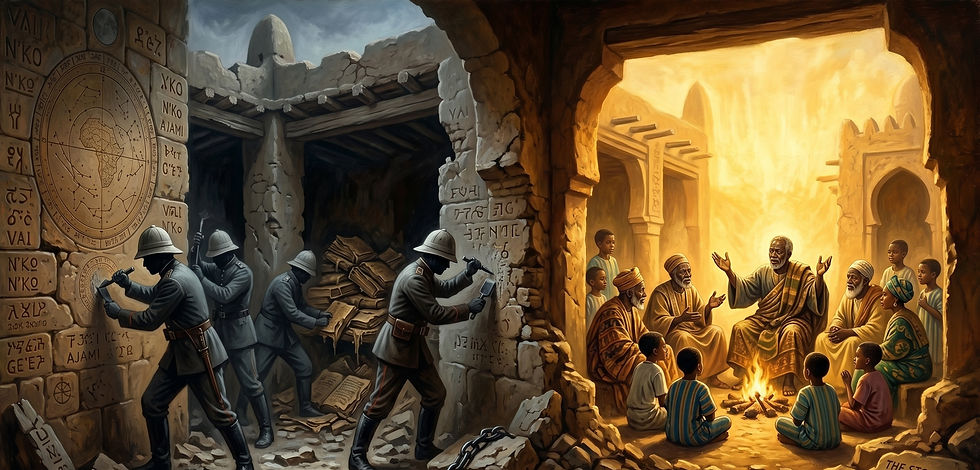
Why African History Was Systematically Hidden
If African civilisations were so advanced and so foundational to the human story, why do so few people know about them? The answer is not accidental. It is the result of a deliberate, centuries-long campaign of suppression.
The Slave Trade and the Myth of Inferiority
The transatlantic slave trade, which forcibly removed an estimated 12.5 million African people from their homelands between the 15th and 19th centuries, required a justification. Enslaving a people recognised as civilised, intellectually sophisticated and culturally rich would have been morally untenable even by the standards of the time.
And so a myth was constructed: that Africans were primitive, uncivilised, without history, without culture. European scholars, missionaries and colonial administrators worked to build a false intellectual framework that placed Africa at the bottom of a fabricated racial hierarchy. History books were rewritten. Archaeological achievements were attributed to foreign visitors rather than African builders. The achievements of Kemet were deliberately severed from their African roots.
“The most potent weapon in the hands of the oppressor is the mind of the oppressed.”— Steve Biko
Colonial Education and the Destruction of Indigenous Knowledge
When European powers divided Africa at the Berlin Conference of 1884–85, they seized not just land and resources but knowledge itself. Traditional libraries were destroyed. Oral historians were displaced. Local languages were suppressed in favour of European ones. Educational curricula were redesigned to begin African history with European arrival, as if nothing of significance had existed before.
This is not only a historical injustice. In many African nations today, school curricula still reflect these colonial-era frameworks. The story of Africa’s independence movements, including the visionary leadership of figures like Kwame Nkrumah of Ghana, who called for a united, self-determined Africa, remains underrepresented or misrepresented in mainstream global education.
The Rupture of Identity
Identity is built from story. When you know where you come from, your ancestors, your traditions, your heritage, you have a foundation to stand on. When that story is taken from you or replaced with a narrative of inferiority, the psychological damage runs deep and lasts across generations.
For African diaspora communities, particularly those descended from enslaved people, this rupture was total. Families were deliberately separated. Languages were forbidden. Names were replaced. Spiritual practices were suppressed. The connection to African history and ancestral identity was systematically severed, by design.
DID YOU KNOW In many slaveholding territories, it was illegal for enslaved Africans to read, write or gather in groups. The suppression of knowledge and communication was not incidental — it was a core instrument of control. |
The Global Cost of Forgetting
The erasure of African history did not only harm African people. It damaged the whole of humanity. When we remove the root from the tree, the whole tree suffers.
A Crisis of Identity and Belonging
Across the world, societies are experiencing a profound crisis of identity. In an era of globalisation and rapid change, people are searching for roots, for meaning, for a sense of who they are and where they come from. Yet the very foundation of that search, the shared African origin of all human beings, has been largely erased from collective consciousness.
The result is a world in which people believe themselves to be fundamentally separate. The artificial hierarchies invented to justify colonial exploitation have calcified into cultural assumptions that persist long after the formal end of empire.
The Invented Logic of Race
Race, as a biological category, does not exist in any meaningful scientific sense. The genetic variation between two individuals within a so-called racial group is greater than the variation between groups. What we call ‘race’ is a social construction, invented in the 17th and 18th centuries to justify the exploitation of enslaved and colonised peoples.
Yet the consequences of this invention are very real and very present. Restoring an accurate understanding of African history, one that reveals Africa as the common ancestor of all humanity, is one of the most powerful tools available for dismantling the false logic of racial hierarchy.
The Loss of Ecological Wisdom
There is another dimension to this loss that is rarely discussed: the ecological one. Africa’s ancient cultures did not view humanity as separate from or superior to the natural world. Indigenous African knowledge systems encoded sophisticated understandings of ecological balance, sustainable land management and the deep interconnectedness of all living systems.
As these knowledge systems were suppressed and replaced by extractive industrial models, which treat the natural world as a resource to be consumed rather than a living community to be respected, the ecological consequences became catastrophic. The climate crisis we face today is, in part, the consequence of forgetting this ancient wisdom.
“We stand at the edge of what we have always known. To move forward, we must first remember where we came from.”

Remembering as an Act of Healing
The restoration of African history is not a political act, it is a healing one. And that healing is available to everyone, regardless of background or ancestry.
For African and Diaspora Communities
For people of African descent, reconnecting with African history is an act of profound self-restoration. It means reclaiming a story that was taken, understanding that your ancestors were not merely victims of history, but architects of civilisation. It means standing on solid ground, knowing that your heritage includes the libraries of Timbuktu, the engineering of Kemet, the philosophy of Nubia and the astronomy of the Dogon.
For diaspora communities navigating identity across cultures and continents, this reconnection can be transformative. Travelling back to ancestral lands, whether physically or through story, film and study, provides a kind of homecoming that no external success can replace. This is not about rejecting present identity. It is about adding depth, roots and ancestral memory to whatever life you are building now.
For Non-African People
For people who do not identify as African, the restoration of African history offers something equally profound: the realisation that you too are a descendant of Africa. Your most ancient ancestors walked the African savanna, spoke African languages, held African cosmologies. Africa is not someone else’s ancestral home, it is everyone’s.
When you understand that the people whose history was erased and whose ancestors were enslaved are not ‘other’ but family, literally, in terms of shared ancestry, something shifts in how you see the world. Understanding grows where separation once stood.
Ancestral Wisdom as Living Practice
Reconnecting with ancestral wisdom is not only an intellectual exercise. For Nuakai Aru, it has been a lifelong embodied practice. Through decades of martial arts training, including the ancient warrior traditions of Muay Boran and Muay Thai, he has explored how ancestral knowledge encoded in physical practice can heal the body, centre the mind and reconnect practitioners with something far older and deeper than the individual self.
This principle, that wisdom must be lived, not merely studied, lies at the heart of the Wisdom Foragers mission. History is not just something that happened. It is a living resource. A map. A medicine.
DID YOU KNOW Many traditional African knowledge systems were encoded not in written texts but in music, dance, oral poetry, textile patterns and embodied practices. This made them resilient across generations — but also deeply vulnerable when communities were forcibly dispersed. |
How to Go Deeper: Wisdom Foragers Resources
If this article has stirred something in you, a curiosity, a sense of recognition, or a desire to know more, the Wisdom Foragers catalogue offers carefully crafted entry points into this history, designed to educate, inspire and move you.
The Films
Humanitree is a 90-minute feature documentary following eight young people as they trace the full story of humanity from its African origins to the present day. It is the most comprehensive screen introduction to the themes of this article, and it is genuinely moving.
Nubian Spirit takes you deep into the ancient world of Sudan and the Nile Valley, exploring the kingdoms of Nubia and Kush that preceded and profoundly influenced what we now call ancient Egypt. Beautifully filmed, it restores one of history’s most overlooked civilisations to its rightful place.
Africa’s Black Star tells the story of Kwame Nkrumah, Ghana’s first president and one of the 20th century’s most visionary leaders. His fight for African independence and his dream of a united continent speak directly to the themes of identity, sovereignty and historical memory explored in this article.
The Lion Mountains is an intimate documentary following a Black British man travelling to Sierra Leone for the first time to connect with his ancestral homeland. It is one of the most powerful portraits of diaspora identity and the healing potential of return available on film.
The Book
The Essence of Muay Thai by Nuakai Aru, published by Shambhala/Penguin Random House, is a deep exploration of the ancestral warrior traditions of Thailand — their spiritual roots in Buddhist philosophy, their history as a system developed to protect a kingdom, and their transformative power as a living practice. While rooted in Thai culture, the book’s exploration of how ancient knowledge systems heal and transform the individual speaks to the same principles that animate African ancestral wisdom. It is essential reading for anyone interested in the intersection of body, spirit and cultural heritage.

When Humanity Remembers, Humanity Rises
We are living through a moment of profound global reckoning. Old stories are breaking down. New ones are urgently needed. And the most powerful new story available to us is, in fact, the oldest one: that we are one species, one family, with a shared origin and a shared destiny.
African history is not a footnote. It is the opening chapter of the human story. To understand it is to understand ourselves, all of us. To restore it is to restore something that was taken not just from African people, but from the whole of humanity.
The work of Wisdom Foragers is the work of remembering. Through film, through story, through ancestral wisdom practices and through education, we are committed to bringing this history back into the light, not to assign blame or create new hierarchies, but to restore the truth that makes us whole.
When we know where we come from, we know who we are. When we know who we are, we know what we must do.
“When humanity remembers its roots, humanity rises.”


Comments